
Financial Typesetting explained
Typesetting is an important step in getting a document ready for print. Along with artworking and design, it’s one component of getting a document ready to be put in front of your readers.
For shareholder and investor communications like IPO prospectuses, annual reports, and merger & acquisition, rights issues, and fund raising documents, typesetting has its own special importance. Beyond making the document look good, it’s also about meeting the requirements of regulators, accurately conveying crucial information to investors and stakeholders, and doing it all to tight deadlines.
In this article, we’ll take a look at what makes financial typesetting different from other kinds of typesetting, where it fits into the print process, and how to make sure your documents are properly typeset for your needs.
This article covers the following topics (click to jump to different sections):
- What is typesetting?
- How is financial typesetting different?
- How does financial typesetting fit into the print production process?
- Formats used for financial documents
- Getting financial typesetting right
What is typesetting?
Financial typesetting is a highly specialised kind of typesetting, so it’s easiest to start by explaining what typesetting is and how it adds value.
Typesetting is the arrangement and styling of text so it’s readable, consistent and visually balanced throughout. It’s usually carried out by the printer and focuses on font, spacing, hierarchy and alignment.

By introducing and structuring those elements, typesetting highlights key elements of a document and structures them in a way that guides the reader through them in a logical and visually pleasing way.
More than just making the document look nice, typesetting helps to turn a page of text into something a reader will understand and properly follow. For complex documents with a lot of figures, it’s often a crucial step to making the final product fit for purpose.
Typesetting is often carried out alongside print design and artworking. Read our article on artworking to find out more about those steps of the print production process.
How is financial typesetting different?
To understand why financial typesetting has evolved as a separate discipline, it’s worth first looking at different types of financial documents and why their requirements differ from other types of print.
Financial typesetting refers to the typesetting for specific kinds of financial documents, such as; IPO prospectuses, annual reports, and merger & acquisition, rights issues, and fund raising documents. These documents are used to provide information on a company’s performance to shareholders and regulatory bodies. Accuracy and legibility of data, therefore, aren’t just a matter of quality control, they’re often legal requirements, with deadlines that are legally set and immovable.
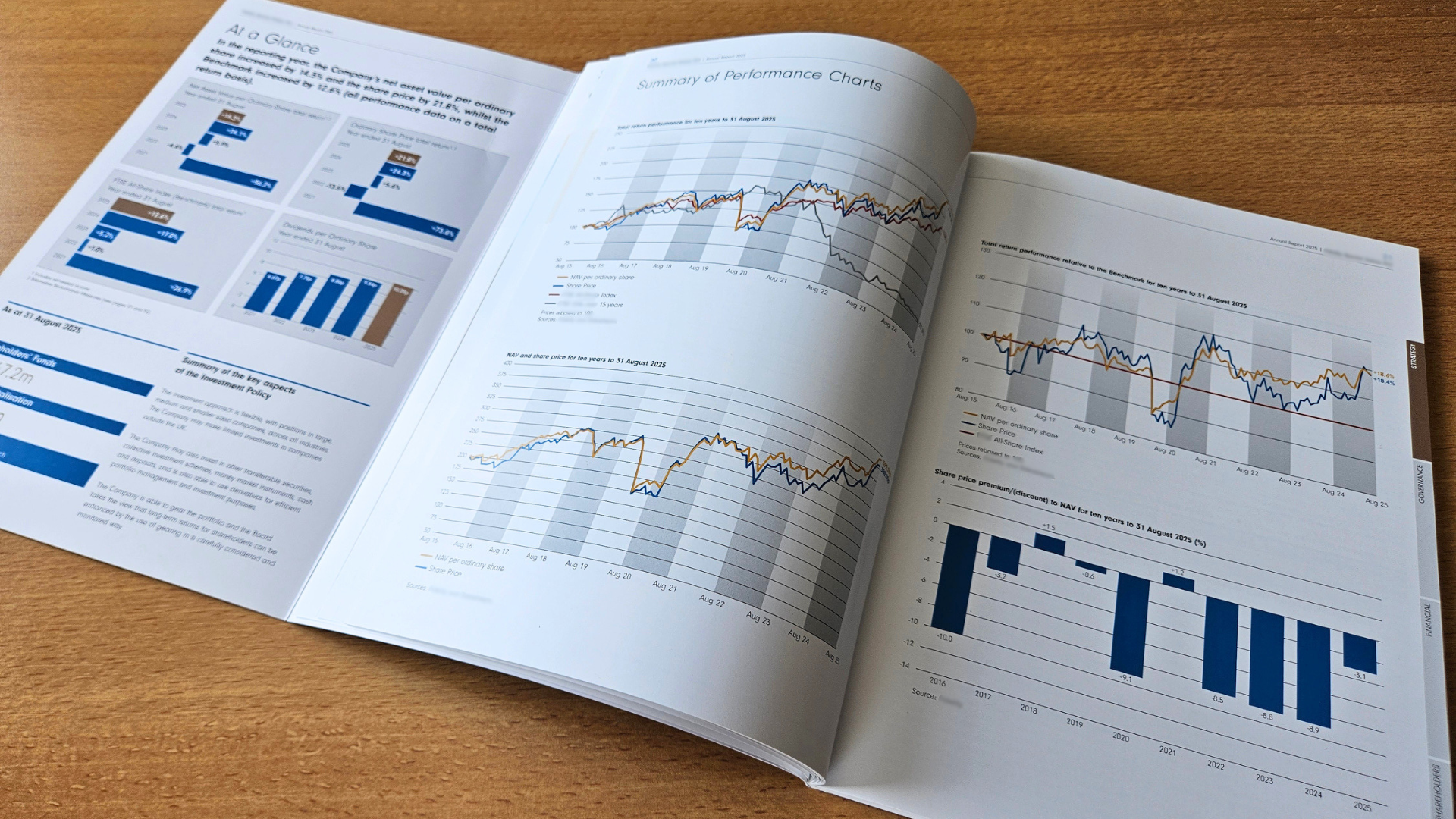
These documents are often dense with data. They can include pages of data tables of accounts, and numerous interrelated graphs. These can be difficult for readers to easily follow or understand without expert management. Data visualisation is a key part of what sets financial typesetting apart: properly formatting, positioning and contextualising tables, graphs and charts, to improve ease of reading and ensure company data is conveyed accurately.

Annual report typesetting
All companies active in the UK are required to submit their accounts to Companies House at the end of each financial year, documenting the company’s performance during the previous year and the position of the company at the point of submitting.
A financial year ends every 12 months from the day the company was incorporated. This represents an immovable deadline for submission, that the typesetters will work to.
Specialist printers and typesetters, who understand the need for accuracy, the strict nature of the regulatory deadline and the complex way data is sourced, will work 24 hours a day in the run up to make sure a deadline is hit, making them valued partners in delivering this sort of document.
The accounts will often also be sent to shareholders and other stakeholders in the company.
Companies House has its own document format, while the annual reports sent to shareholders will be printed and bound or provided as an interactive PDF.
Typesetting documents for IPO listings
IPO listing documents made available to prospective investors ahead of a company floating on a stock exchange. They’re required by the FCA as part of making a stock available to be publicly traded.
They are printed either as a prospectus for investors or a separate registration document that is followed up by a full prospectus.
The FCA stipulates IPO listings prospectuses “must be written and presented in an easily analyzable, concise and comprehensible form.” as well as containing key details on the assets, liabilities, profits, losses, financial position, and prospects of the issuer of the shares.
These documents will be printed or provided as PDFs, with key details, such as the lengths of certain sections, strictly mandated by the FCA. So, for similar reasons to annual reports, printing and typesetting for these documents generally falls to a specialist printer.
How does financial typesetting fit into the print production process?
Now, we’ll take a look at the range of different activities that comprise financial typesetting. The major differences, when compared with typesetting other kinds of print, are the large data visualisation needs of financial documents and the need to produce them in multiple digital and physical formats for different audiences.
Concept development
Financial typesetters will work to understand the project and advise on how best to present it in the necessary formats and styles for both stakeholders and regulators. They may work directly with auditors, accountants and other employees of a company to properly understand and collate data.
Text and layout design
Some financial documents have strict guidelines on presentation, others serve more of a marketing function and so are designed with more of an eye to being attractive and branded.
In either case, a typesetter will work to help choose typeface, sizing and spacing that work best for a project, and will lay out the design to meet any regulatory requirements and design needs for the document.
They’ll also structure it, focusing on hierarchy, consistency and legibility, so that the document is easy for humans to read and understand and, if necessary, optimised for software to read as well.
Data visualisation

Typesetters will work to create graphs, tables and other visual illustrations that match the design of a document, and incorporate them into the layout in a way that makes most sense.
Some documents, like accounts, contain large tables of figures, constituting the vast bulk of the document. When preparing these for printing or submission to official bodies, a typesetter will ensure data is properly presented and everything required is present.
Proofing and blacklining
Proofing and blackling are the steps that ensure a client is fully happy with the document before it is distributed.
At the proof stage, the client will either sign off the layout, design and content of the document or suggest changes that need to be made to it. Some documents will go through several rounds of proofing.
Blacklining is the process of revising content within a document. It is similar to the track changes function in Microsoft Word or Google Docs.
The large amount of data and the need for it to be up to date mean the content of many financial documents will change right up to the last minute. Blacklining allows this to happen alongside the design of layout and format, right up to the deadline. In these cases, the typesetters will work with a template version at the same time that content is being created, getting ready to quickly insert the finished content into the final layout.
Some typesetters will have software to allow real-time blacklining, so a client can constantly work on a document throughout the typesetting process. Others will provide a version of the document for blacklining at regular intervals.
Preparation of the final document
Once all of the above steps have been completed, a document is ready for distribution. Often this will be to shareholders and employers of a company, as well as regulatory bodies, like Companies House or the FCA, that require information to be provided in specific formats.
To meet these requirements, financial typesetters will work to develop a master document, from which all the other formats can be generated,
Formats used for financial documents
As briefly discussed in the section above, some regulatory bodies and document types require specific and specialised formats. Financial typesetting can include the preparation of files in many or all of these specialised formats from the master document. In this section we’ll take a look at some of the common formats that typesetters will prepare a document in.
XBRL and iXBRL
XBRL (which stands for eXtensible Business Reporting Language) and iXBRL are formats designed to be readable by software. This allows the data to be processed reliably and efficiently for analysis and reporting. It’s commonly used for financial statements and accounts.
XBRL refers to a software that’s used to add computer-readable tags to a document. The software was developed in response to the proliferation of proprietary tagging softwares in the past. Each of these systems had separate tags that were meaningless in any other system, which undercut the efficiency savings by requiring the preparation of multiple tagged files.
By contrast, XBRL is an international standard, used by government agencies, accounting firms, software companies, corporations, academics and business reporting experts.
In the UK, ‘inline XBRL’ or iXBRL is used. This refers to a document prepared with XBRL tags that is also readable by human readers.
The inclusion of XBRL tags does not have to influence the design or presentation of the document, so layout, style, and imagery can all be prepared in keeping with a company’s brand. Typesetters will prepare the hidden tags as part of the typesetting process.
xHMTL
xHTML is a version of HTML, the common file format for web pages, with some modifications to make it easier to style for readers.
Some regulatory bodies require documents to be prepared in xHTML formats. This is to ensure maximum compatibility across different countries, companies and systems, as xHTML documents can be read in any internet browser and no specialist software is required to access them.
Certain financial documents, like annual reports, are required to be submitted in xHTML format across Europe, and preparation in xHTML is one of the requirements of ESEF.
ESEF
ESEF (European Single Electronic Format) refers to the requirement to prepare all annual financial reports across Europe in a single, digitally readable format.
The requirements of ESEF documents are that they be prepared as xHTML documents for human readers and marked up with iXBRL for software, and to ensure there is no difference between the two versions.
Documents prepared in the ESEF format are both easily readable and optimised for data to be extracted.
Interactive PDF
PDFs are one of the most common file formats, combining elements of text, graphic and multimedia formats. They’re often used to present documents designed for print on screen in a mostly faithful way.
Interactive PDFs are designed for human audiences and, unlike other common financial document formats, will often be highly designed.
The interactive element refers to customisable icons, which make a document easily navigable.
Companies House
Companies House stipulates a strict style for submissions made to them. This doesn’t limit design or branding choices, but focuses on minimising the size of digitally submitted files.
Documents prepared for Companies House must be PDFs. The content must be in black and white, with no other colours, and they should not include any images.
When preparing a Companies House submission from a master document, typesetters will make adjustments where necessary so that no information is lost or obscured when adapted from more heavily designed documents.
Often a document won’t just be prepared for one kind of recipient or in one format. Specialist financial typesetters can prepare the same document for multiple formats simultaneously, often working from master documents, to avoid unnecessary repeated work.
They will also be able to advise what formats a document should be prepared in.
Getting financial typesetting right
Typesetting exists to make sure a document is laid out and presented in a way that effectively achieves its goals. For financial typesetting, that means legible data, accurate and easy to understand information, and a readable style.
The best way to achieve this is to work with a specialist financial printer or typesetter, who will understand the complexities and priorities of your document.
Specialist financial typesetters will be able to manage processes like blacklining and proofing alongside creating data visualisations, and will work round the clock to ensure you’ll be ready to deliver on those all important deadlines.
Park|Graphius’s financial typesetting team can manage the end-to-end process of printing shareholder and investor communications. To find out more about this service, please get in touch with us here.


